
Inside Mecosta County Tax Records
Tax information in Mecosta County lives in several places. Local assessment rolls each hold a piece. So do county Equalization resources, BS&A services, FetchGIS reports, and treasurer accounts. The assessment side names the parcel, class, land and building data, and value fields. The collection side is different. It records the bill, payment history, delinquency, and settlement status. Two sides matter. Equalization reviews city and township rolls and lifts each class to the countywide level. The local assessor sets the individual parcel assessment.
| Tax field | Meaning in the record | Official source |
|---|---|---|
| MBOR Assessed | Prior-year March Board of Review assessed figure shown in the GIS report | Local assessor and FetchGIS |
| Final SEV | State equalized value after equalization | Assessment roll and FetchGIS |
| Final Taxable | Tax base after Michigan limits and applicable exemptions | Assessment roll and FetchGIS |
| Class and PRE | Assessment class and principal-residence exemption treatment | Local assessor and Equalization forms |
| Year, season, and total due | Tax-history labels, including summer or winter context | FetchGIS and collecting treasurer |
| Settlement or delinquency | Portal status that still requires a current account check | Local or county treasurer |
Michigan generally sets state equalized value at 50 percent of true cash value. Taxable value can follow a different path. It can uncap the calendar year after a transfer. A sale price does not become true cash value. Nor does it direct the assessor to set the assessment at exactly half that price. The Michigan Tax Tribunal glossary supplies the formal terms, while the displayed roll supplies the parcel's dated figures.
Mecosta County Assessment Roles
Mecosta County Equalization examines the rolls for 16 townships and the City of Big Rapids. It reports agricultural, developmental, residential, commercial, industrial, and timber-cutover classes. Its job is county equalization to true cash value. It does not set each parcel's first assessment. Questions about one record start with the local assessor. The Equalization page links township assessors, annual reports for 2023 through 2026, millage material, apportionment reports, tax maps, forms, and GIS. Tax-map PDFs exist for all 16 townships. They can identify the likely local unit when a mailing city is misleading. A recorded deed or plat remains the better source for a legal description or boundary. Open the official Equalization page to browse those sources directly. The county's Equalization screen shows the breadth of the menu.
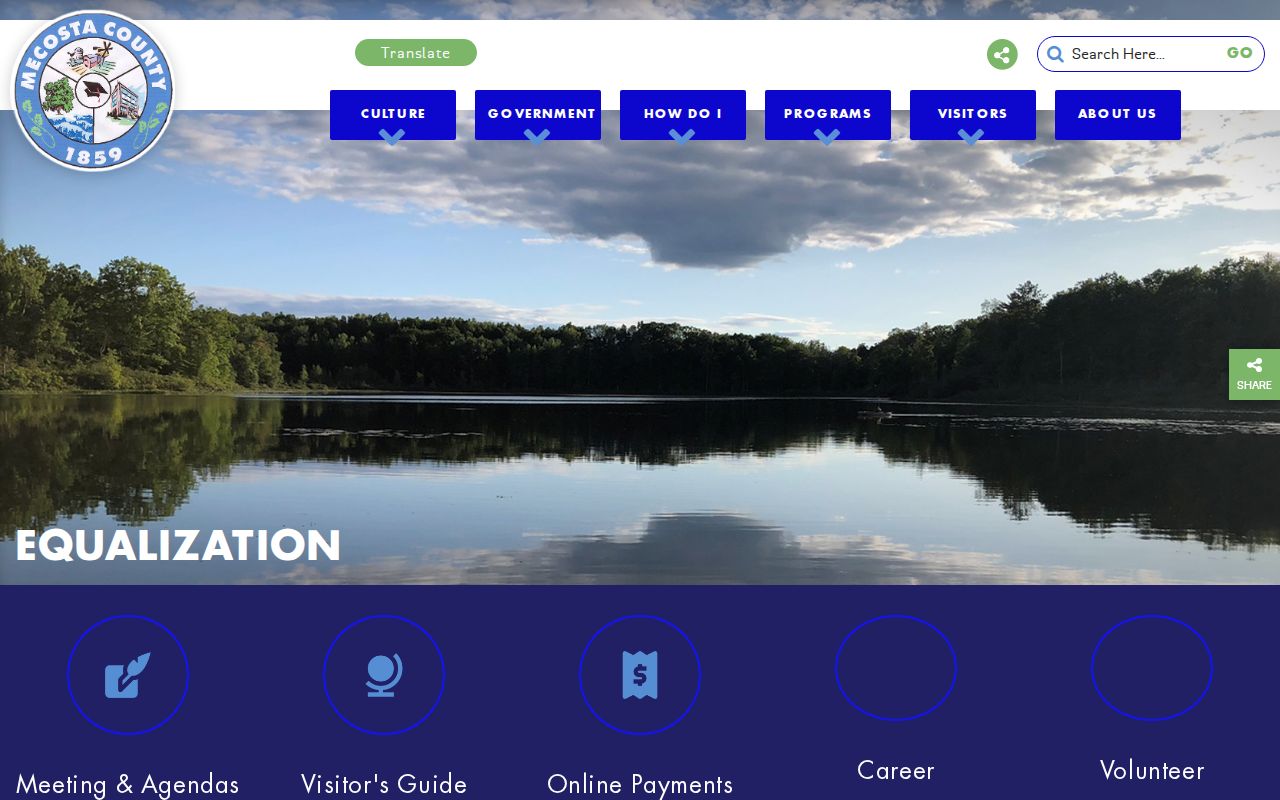
Annual reports, township tax maps, assessment forms, and GIS links sit together on the county's Equalization page. No single menu item is the full tax record.
Mecosta County Tax Search Fields
The county-linked BS&A Online service routes searches to local data. Address, name, and parcel number are the basic fields. Its county home also identifies assessing, property sale, building department, delinquent-tax, detailed-record, and payment services. Select the correct municipality first. Assessment remains a local-unit function. Results depend on the unit chosen.
| Search route | Useful input | Record to save |
|---|---|---|
| Assessing Search | Address, Name, or Parcel Number | Current roll and appraisal-card fields |
| Property Sale Search | Date, price, grantor, grantee, class, building traits, neighborhood | Dated assessment sale row |
| Delinquent Tax Search | Parcel or local account route | Status displayed, followed by treasurer confirmation |
| Building Record Search | Municipality and parcel details | Assessment or department record, not zoning approval |
The BS&A county service page lays out a menu of local records. The menu is a starting point. No local unit is guaranteed to publish every field.
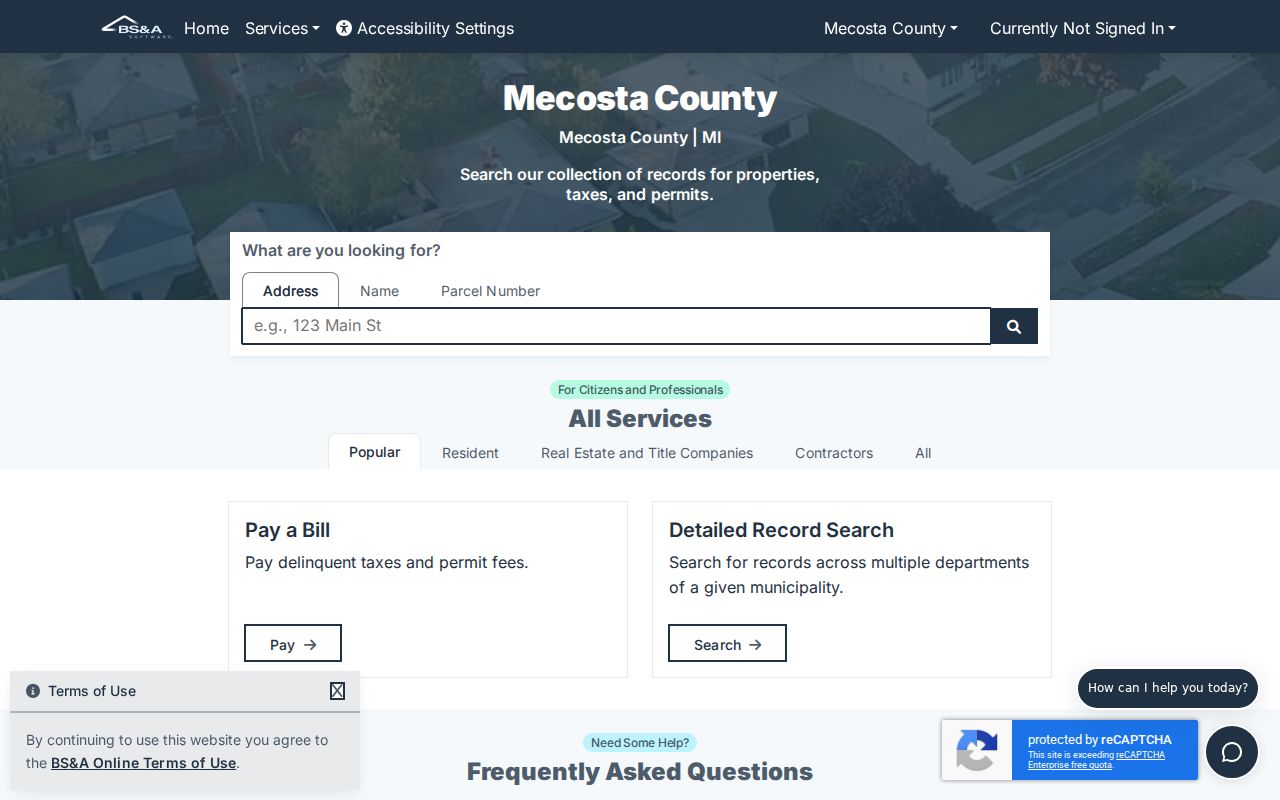
The official BS&A menu separates assessment, sale, building, tax, and payment searches. That separation matters. It keeps a sale-search row from being mistaken for a current bill.
Trace a Mecosta County Tax Bill
Fix the parcel and local unit first. Then separate the assessment from the current amount owed. The county states that assessment rolls and appraisal cards are open for inspection and copying under the General Property Tax Act. Some local units offer a public terminal. That terminal is a useful fallback when a web result is missing, old, or unavailable.
- Find the PIN in FetchGIS or the correct local BS&A unit. Confirm the property address, assessing unit, and current tax year.
- Read MBOR Assessed, Final SEV, Final Taxable, class, PRE status, and tax history as separately labeled fields.
- Identify whether the question concerns a summer bill, winter bill, prior settlement, delinquency, or a current payoff.
- Contact the city or township treasurer for current collection. After taxes are forwarded, confirm the account with the Mecosta County Treasurer.
- Assessed value
- The local assessor's value before county and state equalization steps.
- True cash value
- Michigan's term for the property's usual selling-price concept, subject to statutory guidance.
- Taxable value
- The value used as the tax base after constitutional limits, uncapping rules, and exemptions.
- Millage or levy
- The rates applied by taxing authorities to the taxable value.
- Tax lien
- A recorded or statutory claim tied to unpaid tax, not proof that foreclosure is complete.
Keep a copy of the dated result. A GIS settlement date is not payment today. The responsible treasurer can distinguish a tax-roll entry, payment history, delinquency notice, payoff, redemption record, or foreclosure document.
Mecosta County Tax Calendar
According to the Mecosta County Treasurer, summer bills are dated July 1 and due without penalty by September 14. A 1 percent monthly penalty follows that date. Winter bills are dated December 1. Townships may add 3 percent after February 14 through February 28. Delinquent summer and winter taxes move to the county treasurer on March 1 of the next year. The page also describes the PA 123 of 1999 process. Property 23 months delinquent can be foreclosed. Foreclosed property may be sold at state auction. After one year delinquent, stated interest changes to 1.5 percent per month, with a $175 forfeiture and administrative fees. A portal flag alone does not prove foreclosure. The official treasurer calendar and delinquency explanation carries the full detail.

Dated rules help route an account to the right office. Still, only the responsible collector can quote a current balance.
Mecosta County Exemption Forms
Mecosta County Equalization posts a set of state forms that shape the tax roll. A principal-residence exemption rides on Form 2368. Form 2602 rescinds or withdraws a homestead exemption, and Form 4640 handles conditional rescission. Farmland exemption uses Form 2599. Qualified agricultural property uses Form 3676. Form 2766 covers the property transfer affidavit.
Form 2368 itself is straightforward but detailed. It wants the property tax ID, the local township or city, the county, the street address, and the owner. It also wants a mailing address when that differs. File it with the local assessor, never with the State of Michigan. The instructions tie a June 1 filing to summer and winter levies. Later dates apply only to the winter levy. The form carries sensitive identifying fields. Treat the blank version as a filing reference, and never republish a completed copy.
Note: An exemption changes taxable treatment; it does not establish title, occupancy history, or a market appraisal.
Mecosta County Transfers and Uncapping
A sale rarely lines up neatly across county systems. The recorded deed may exist before the assessor roll reflects it. Michigan guidance says taxable value can uncap in the calendar year after a transfer. Keep two more points in mind. The sale price does not automatically become the new true cash value. It is also not a command to set assessed value at exactly one-half of the sale price.
Timing questions call for comparison. Check the recorder's filing date. Compare it against the roll's current tax year and the displayed sale record. When dates do not match, ask the local assessor or Equalization whether the roll has caught up. Mecosta County publishes no countywide deed-to-assessor refresh guarantee, so assume no fixed lag.
Date check. Preserve the deed recording date, assessment year, and portal report date before deciding that two Mecosta County value fields conflict.
Mecosta County Tax Access Channels
The web is not the only way in. The county tax records page links assessment and tax services. It also confirms public inspection and copying. A local assessor or collecting unit may offer a terminal or paper copies. Equalization hands out tax maps, assessor contacts, forms, and annual reports. Current collection belongs to the city or township treasurer. The county treasurer takes forwarded delinquent taxes.
The county's public-access page displays these systems as the official source presents them.

An account-specific payoff still rests with the collecting office, whatever the public systems show. For a county-held field that goes unpublished, a sufficiently specific Michigan FOIA request can reach the county coordinator in person, by mail, fax, or email.
Contest a Mecosta County Assessment
A dispute over an individual assessment starts with the local assessor, not Equalization. Gather the parcel card first. Add current and prior value rows, class, land and building attributes, and recent comparable sales. Bring any error in acreage or description too. Ask the assessor for the current review calendar and the required form. No single countywide filing deadline governs every local unit. Verify the active cycle rather than trusting a generic date.
Know what the numbers mean before stating a claim. True cash value, assessed value, state equalized value, and taxable value each matter here. Each plays a different role. A current balance or penalty belongs with the treasurer instead. And a fight over ownership or a legal boundary needs the deed, plat, court order, or survey. That is not a tax appeal.
Confirm the window. Contact the parcel's city or township assessor for the current review date, filing rule, and appeal path before the local deadline passes.