
Compare Mecosta County Property Values
Labels matter more than size. Michigan's tax system keeps assessed value, state equalized value, and taxable value in separate boxes. True cash value gets its own box. A deed or sale-search record adds yet another figure tied to a transaction. To compare Mecosta County property values fairly, use the same tax year. Use the same label too. No source promises that any single figure equals a current sale price.
| Value Type | What It Means | Where It Is Recorded |
|---|---|---|
| Assessed value | Local assessor's parcel value before county and state equalization | Assessment roll and parcel report |
| State equalized value | Equalized figure generally set at 50% of true cash value | Assessment roll as Final SEV |
| Taxable value | Figure used in the property-tax calculation, subject to Michigan limits and uncapping rules | Assessment and tax record |
| True cash value | Michigan's value concept tied to usual selling price, not a promise of a sale result | Assessor and tribunal framework |
| Last sale price | Amount reported for a past transfer, subject to the deed and local processing | Recorded instrument and BS&A sale data |
SEV usually runs at half of true cash value. Michigan guidance is clear on one point, though. A sale price is not automatically true cash value, and an assessor is not directed to set assessed value at exactly half of a sale. Match dates and labels first. Only then draw a conclusion.
Read Mecosta Assessment Rows
A FetchGIS property report can show the current tax year plus prior-year rows labeled MBOR Assessed, Final SEV, and Final Taxable. MBOR refers to the March Board of Review stage. The same report may list acreage, zoning, land value, land improvements, building characteristics, sales information, and tax history. Those extra fields help explain a parcel comparison. Still, none of it replaces a licensed appraisal.
Read each label exactly as published. Final Taxable is not Final SEV. Neither one should be renamed market value. Keep the report date, tax year, parcel PIN, and assessing unit with the number, so a later reader has the full context.
Mecosta Equalization Reviews the Rolls
Mecosta County Equalization examines township and city assessment rolls. It equalizes them to true cash value. The department works to a 50% equalization level and publishes annual reports. It also posts millage material, assessor contacts, forms, tax maps, and GIS links. It also tracks agricultural, developmental, residential, commercial, industrial, and timber-cutover assessment classes. The Equalization page is the county's public route to those resources.

Equalization never sets an individual parcel assessment. That job belongs to the local assessor. The State Tax Commission may review, audit, and change equalization itself. Take any parcel-specific value question straight to the correct city or township assessor.
Look Up Mecosta County Value
The BS&A services page routes you to several tools. These include assessment, sale, building, detailed-search, delinquent-tax, and payment services. FetchGIS offers a second discovery route by PIN, owner name, address, intersection, or coordinates. Confirm the municipality before reading any values, since local assessors maintain the parcel roll. The county BS&A screen displays the service categories available. They appear before a municipality and parcel record are selected.
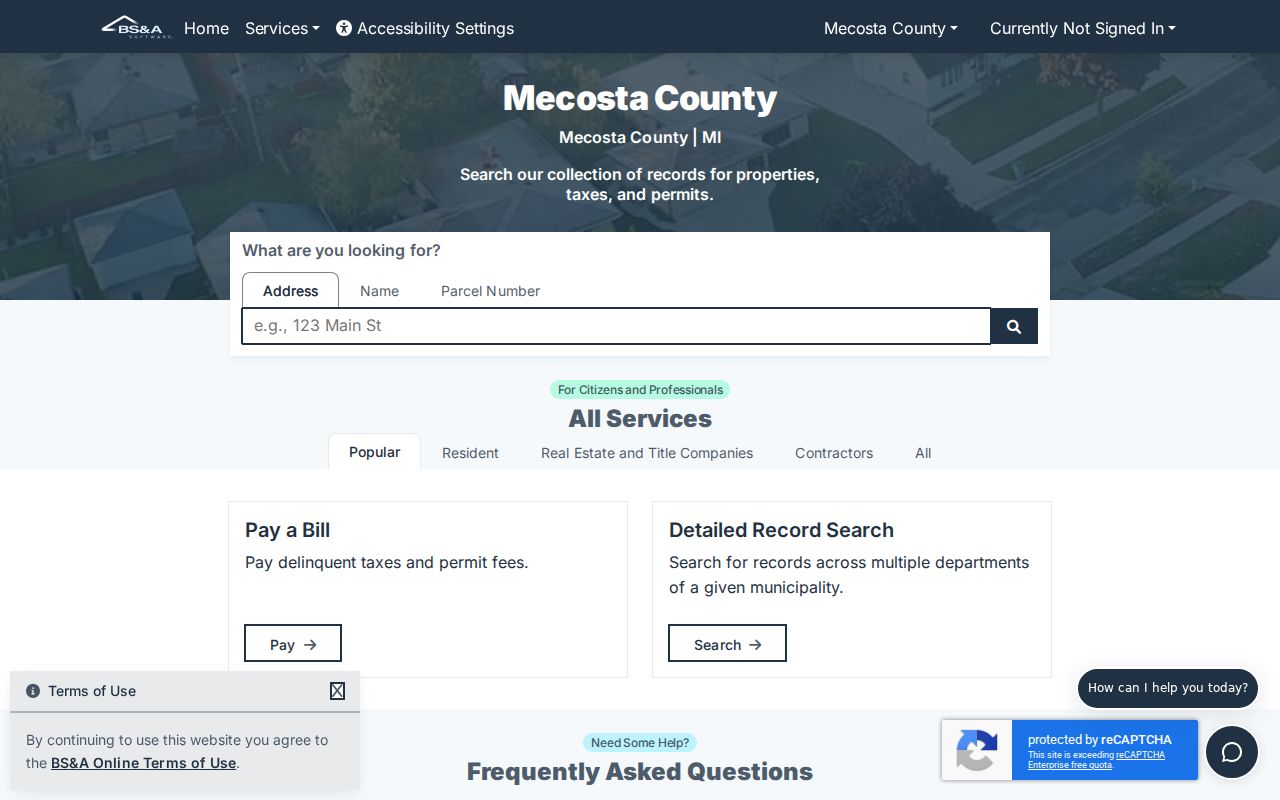
That screen lists the assessment and sale routes only. No parcel value appears until a municipality and record are chosen. Capture the parcel result and its tax year during the lookup itself.
- Search the address in FetchGIS or BS&A. Confirm the PIN, tax description, local assessing unit, and current tax year.
- Copy MBOR Assessed, Final SEV, and Final Taxable exactly as labeled. Record the year beside each number.
- Review land, improvements, class, building attributes, and sale history only as supporting assessment context.
- For a sale comparison, inspect the recorded deed or transfer statement and distinguish its date from the assessor's processing date.
- Assessed value
- The local assessor's valuation before equalization, not taxable value.
- True cash value
- Michigan's usual-selling-price value concept for assessment work.
- Assessment ratio
- The relationship between the equalized assessment and true cash value, generally 50% in Michigan.
- Sale or consideration price
- A transfer amount shown in sale data or a recorded instrument, not an automatic current market value.
- Reassessment
- The process of reviewing and updating assessed values for the applicable roll.
Mecosta Sales Need Date Context
BS&A Property Sale Search offers filters for sale date, price range, grantor, grantee, property class, residential building features, and neighborhood groupings. That makes it a strong tool for comparable assessment records. It also helps with a reported prior transaction. One caution applies. The Neighborhood field is a portal grouping for sale analysis, and it is not automatically a recorded subdivision or a recognized community.
A sale date in the assessment dataset may follow local processing rules. When the exact consideration or legal parcel matters, confirm the transfer against the recorded instrument. The deed's recorded date can differ from its execution, closing, and assessment dates. Preserve each date type separately. Do not merge them into one event.
Note: A single sale may be unusual, non-arm's-length, or tied to terms an assessment search result cannot show.
Transfers Can Uncap Mecosta Taxable Value
Under Michigan's transfer-of-ownership rules, taxable value can uncap in the calendar year after a transfer. That is one reason Final Taxable may sit far from SEV. It also explains a schedule quirk. The taxable figure can change on a timeline that ignores the closing date. Whether a transfer occurred under the state's rules drives part of the effect. So does whether an exemption applies.
Form 2766 is the Property Transfer Affidavit. Other county-linked forms cover the Principal Residence Exemption affidavit. They also handle rescissions and conditional rescissions. Farmland and qualified agricultural property forms round out the set. These documents shape tax treatment. An exemption-adjusted taxable figure, though, does not redefine the property's market value.
Mecosta Property Classes Are Not Zoning
Equalization lists agricultural, developmental, residential, commercial, industrial, and timber-cutover classes. BS&A adds class filters to its sale search. Classification organizes assessment and sales work. It never tells a buyer what the zoning ordinance permits on a parcel.
A parcel report may show a zoning field of its own. Even so, verify it with the responsible city, village, or township. Big Rapids runs its own land-use process. Morley publishes no stable searchable permit index. Barryton lists six zoning-district labels. Keep assessment class, zoning district, and actual legal use as three separate facts.
Compare Mecosta Values Across Years
Mecosta County's Equalization page posts annual reports for 2023 through 2026. It also describes two-year residential sales studies in its public material. Those reports give county and class context. They do not replace the local assessor's parcel record or set one property's assessment.
Compare wisely. Hold the parcel PIN, labeled value, assessment stage, and local unit constant across both years. Watch for splits or combinations. Note new improvements, demolition, class changes, exemption changes, and transfers when those facts are visible. Without that context, a percentage change may compare unlike records.
The GIS report schema splits land information from improvements. Building traits can appear there too. These include year built, style, exterior, living area, foundation, basement, garage, and accessory features. Those fields may explain why nearby parcels differ. They still need a shared tax year and class for a fair comparison. A visible sketch or building field does not prove current dimensions or approved work.
What Mecosta Property Value Omits
An assessed value proves little on its own. It cannot establish a current sale price, title condition, exact boundary, building compliance, or the cost to repair a structure. GIS building fields help distinguish parcels, but they are not a condition inspection. A recorded sale is history, not a standing offer. A lender or buyer may need a qualified appraisal tailored to the date and purpose.
The same caution applies to taxes. A tax-history field is not a payoff statement. The Mecosta County property tax records process covers bills, delinquency, and the responsible treasurer. Know what each number means and where it was published.
A published value can look stale. When it does, compare the recorder's filing date with the assessment or GIS report date. Mecosta County publishes no official countywide deed-to-assessor update timeline. Contact the local assessor or Equalization instead of assigning a guessed lag. If the question is what the land would sell for on a specific date, seek market evidence and a qualified appraisal made for that purpose.
Michigan's framework adds another wrinkle. Taxable value and SEV can move for different reasons. A transfer, exemption, or annual limit may affect taxable value without any change in the assessor's view of true cash value. State guidance and the Michigan Tax Tribunal glossary give the controlling definitions, and the parcel record supplies the actual labels to interpret.
Value versus price. An assessed value supports taxation. It is not a promise of sale price and is not a parcel-specific market appraisal.